Delaware Dog Registration Information
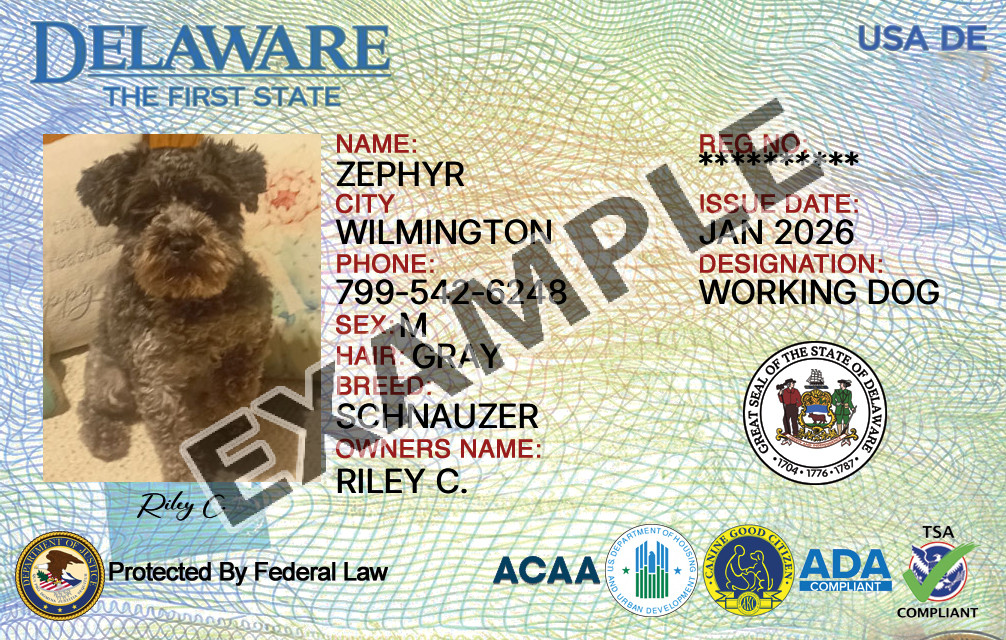
State Licensed, Service Dogs and Emotional Support Dogs in Delaware
Where Do I Register My Dog in Delaware for a Service Dog or Emotional Support Dog?
If you’re searching for where do i register my dog in Delaware for my service dog or emotional support dog, the key point is this: in Delaware, what most people call “registering” is usually getting a dog license in Delaware (and keeping rabies vaccination current). A dog license is a local/state requirement for dogs over a certain age, but it is not the same thing as “certifying” a service dog or “registering” an emotional support animal.
Where to Register or License Your Dog in Delaware
Because licensing and enforcement are often handled locally (and because some cities maintain their own animal control contact points), the best place to start is your local or state animal services office. Below are several official Delaware offices residents commonly use for animal control, dog licensing support, or rabies enforcement guidance. If an item (like office hours) is not publicly listed in the official source we found, it’s left blank.
| Office | Address | Phone | Office Hours | |
|---|---|---|---|---|
|
Delaware Animal Services (Delaware Office of Animal Welfare) — 24-Hour Hotline
Animal control / enforcement intake (statewide)
|
Delaware (statewide hotline)
Street address not listed for hotline contact
|
(302) 255-4646 | DelawareAnimalServices@state.de.us | 24/7 hotline |
|
New Castle County Government Center (general county offices)
County government center (may be referenced for licensing purchase locations)
|
87 Reads Way
New Castle, DE 19720
|
Not listed in the specific source used for this table | Not listed | Not listed |
|
Newark Police Department (City of Newark)
Local animal control contact (as directed by state animal services guidance)
|
220 South Main Street
Newark, DE 19711
|
(302) 366-7111 | MFarrall@newark.de.us | Not listed |
|
City of Dover Police Department (Animal Control)
Local animal control contact (city-level)
|
400 S. Queen Street
Dover, DE 19904
|
(302) 736-7111 | contact@doverpolice.org | 24 Hour Police Agency (non-emergency listed) |
|
Delaware Department of Agriculture — Poultry & Animal Health (Rabies Hotline)
Rabies exposure guidance (animal exposed to potentially rabid animal)
|
Street address not listed in the rabies hotline source used
Delaware
|
(302) 698-4630 | Rabies.Hotline@delaware.gov | Not listed |
Quick tip: “Registering” usually means “licensing”
If you’re trying to figure out where to register a dog in Delaware, start by confirming your dog’s licensing requirement and where licenses are issued or sold in your area. Delaware’s Office of Animal Welfare states that dogs 6 months of age or older must be licensed, and you typically need rabies proof to get the license.
Overview of Dog Licensing in Delaware
What a dog license in Delaware is (and why it exists)
A Delaware dog license is an official license/tag tied to you (the owner) and your dog. It supports core public-safety functions like: identifying lost dogs, encouraging rabies vaccination compliance, and helping animal control return a dog to its owner more quickly. If you’re looking for an animal control dog license Delaware process, that’s typically the same licensing requirement—animal control enforces it, but the license itself is your proof of compliance.
Who is responsible statewide?
Delaware’s Office of Animal Welfare (often referenced through Delaware Animal Services for enforcement intake) provides statewide animal services guidance and a 24-hour hotline for animal control concerns. For rabies exposure questions (especially when an animal is exposed to a potentially rabid animal), Delaware’s Department of Agriculture provides a rabies hotline contact.
Key statewide baseline requirements
- Licensing: State guidance indicates dogs 6 months of age or older must be licensed.
- Rabies proof: A valid rabies vaccination certificate (or a state-authorized exemption) is required to obtain a license.
- Local variation: Fees, where you purchase, and renewal timing can vary by the issuing location and your municipality/county practices.
How Dog Licensing Works Locally in Delaware
Step 1: Identify your issuing office (county/city vs. state partner locations)
In practice, “where do I register my dog” depends on where you live in Delaware. While the state sets baseline rules (like licensing age and rabies proof), residents often obtain the physical tag through local government points of contact or designated partner locations. That’s why many people searching where to register a dog in Delaware feel stuck—the answer is often: your local issuing office.
Step 2: Prepare your documentation
Most dog licensing processes are straightforward. You typically provide:
- Owner contact details (so the license can be tied back to you)
- Dog details (name/description, sometimes spay/neuter status)
- Proof of rabies vaccination (or an authorized exemption certificate)
- Payment for the licensing fee
Step 3: Keep rabies protection current
Rabies rules matter because licensing is directly tied to rabies compliance. If the rabies vaccination expires, you may be unable to renew or obtain a license until vaccination is updated (or an exemption is documented). For exposures (for example, your dog is bitten by wildlife or another animal and rabies exposure is a concern), Delaware provides designated rabies contacts through state agencies.
Service Dog Laws in Delaware
A dog license is not service dog “registration”
A common misconception is that you must “register” a service dog with a registry to make it legitimate. A Delaware dog license is a public licensing requirement for dogs (including service dogs). But the dog’s service dog status is a separate concept: it’s based on the dog being trained to perform tasks for a person with a disability. In other words: your service dog should still have a dog license in Delaware if required by age and local rules, but the license does not “create” service dog rights.
What you can be asked (practically) vs. what licensing proves
Licensing typically proves rabies compliance and ownership information—not disability status, not training level, and not access rights. If you’re dealing with housing, employment, or public access issues, those situations are governed by different rules than dog licensing. If someone is telling you to buy paperwork, pay a vendor, or use an online “certification” site to “make your dog legal,” treat that claim carefully—Delaware licensing is handled through official channels and requires rabies proof, not third-party IDs.
Emotional Support Animal Rules in Delaware
An ESA is not the same as a service dog
Emotional support animals (ESAs) generally provide comfort through their presence, but they are not automatically trained to perform disability-related tasks the way service dogs are. This difference matters because it affects where the animal may go and what accommodations apply.
Licensing still applies
Even if your dog is an emotional support dog, it’s still a dog—and if it meets Delaware’s licensing age threshold, it generally needs the same licensing and rabies compliance as any other dog. So when people ask where do i register my dog in Delaware for my service dog or emotional support dog, the Delaware answer is usually: get the required local/state dog license, keep rabies vaccination current, and handle ESA documentation separately for the specific setting (such as housing).
Frequently Asked Questions
What You May Need
Register A Dog In Other Delaware Counties
Select your county from the dropdown below to get started with your dog’s ID card. Requirements and license designs may vary by county, so choose your location to see the correct options and complete your pup’s registration.
